


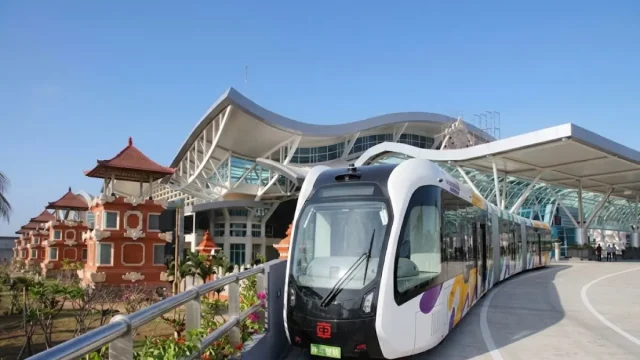
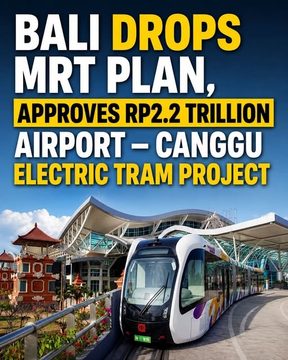
Kompas reports that the Bali Provincial Government, the Badung Regency Government, and PT Kereta Api Indonesia (KAI-Indonesian Railways) have agreed to develop a battery-powered electric tram serving a route connecting Bali’s I Gusti Ngurah Rai Airport and the Canggu area of North Kuta.
This mass-transport rail system aims to support tourism and alleviate traffic congestion on the heavily traveled route. Bali Governor Wayan Koster stated that the tram will not only serve as a transportation solution but also become a new tourist attraction in its own right. “Tourist comfort must be maintained; the tram is actually expected to become a new draw for Bali tourism,” said Governor Koster following a signing ceremony in Denpasar on Tuesday, 01 September 2026.

The Regent of Badung attended the signing ceremony, with KAI President Director Bobby Rasyidin, Angkasa Pura CEO Muhammad Rizal Pahlevi from the Bali Airport Management, and the Badung Regency Regional Secretary.
According to Koster, the tram development follows a proposal prepared by the Ministry of National Development Planning/Bappenas and the Bali Provincial Government. This mode of transport is considered a potential solution to congestion along the I Gusti Ngurah Rai Airport–Canggu corridor, which sees the daily movement of some 150,000 people and 80,000 vehicles.
The planned Airport-Canggu Electric Tram line will span approximately 12 kilometers. Construction will have to artfully navigate a corridor that is home to hotels, tourist accommodations, tourist attractions, residential areas, and local community activities. The Governor emphasized that the construction of transport infrastructure must not disrupt Bali’s ecosystem. “Transport development must respect Bali’s uniqueness, preserve its beauty, support tourism, and not disrupt the lives of the local community,” Koster said.


Unlike conventional trains, the planned trams are smaller, with a width of approximately 2 meters. They are designed to operate quietly and run on batteries, eliminating the need for overhead power lines along the route. Preliminary plans target a travel time of around 30 minutes, with departures every 10 minutes.
The system is projected to carry up to 60,000 passengers daily and handle about 40 percent of the mobility needs in the areas it serves.
Following the signing of the cooperation agreement, the Bali Provincial Government and stakeholders will proceed with technical studies and public outreach, including engagement with traditional villages (*desa adat*).
The groundbreaking for the tram construction is scheduled for March 2027. The first route segment is targeted to begin operations in 2028, while the entire line—extending to Canggu—is expected to be completed and operational by 2029.


KAI President Director Bobby Rasyidin stated that the cultural, environmental, and social aspects of Balinese life would be considered starting from the initial planning stages. “Transportation infrastructure must be developed carefully; technological advancement must not erase Bali’s identity and harmony,” Bobby said.
He noted that battery-based technology was selected to minimize environmental impact and noise. Thus, the tram system is expected to provide comfort for both residents and tourists visiting the “Island of the Gods.”
Related Links
Bali Will Miss the MRT, All Aboard the ART!
Governor Koster: Bali Needs a Stronger Island Infrastructure
Bali Governor and Transportation Minister Discuss North Bali Airport and Water Taxi
Bali’s MRT Subway Project Stalled and Running on Empty?
Stay Informed on Bali Tourism-Related News: Subscribe to Bali Update