


Kompas reports that Bali’s hotel and tourism industry is becoming increasingly complex. Despite official claims of robust provincial economic growth and a post-pandemic tourism recovery, objective market indicators suggest a road ahead marked by economic uncertainty and sluggish tourism demand.
The current pace of property investment and construction lending is outpacing Bali’s hotel market’s ability to absorb additional room supply. Recent research by PT Hotel Investment Advisory (HIA), led by senior investment consultant Ross Woods, reveals that the Island of Bali can no longer be viewed as a monolithic hotel market.
Bali Hotel Market Highly Fragmented
Bali is experiencing sharp market fragmentation, where rising room rates—or Average Daily Rate (ADR)—often mask the ongoing contraction in occupancy levels and weak real demand for room nights sold.
Data from Bank Indonesia (BI) shows Bali’s economy grew by 5.58 percent year-on-year in the first quarter of 2026, remaining relatively stable compared to the same period the previous year (5.52 percent). The Accommodation and Food & Beverage Sector also grew by 6.44 percent.


Declining Hotel Room Demand
However, Bali has recently experienced a sharp slowdown in the influx of foreign tourists. In the first quarter of 2026, foreign tourist visits grew by only 1.04 percent year-on-year to 1.47 million—a significant drop compared to the 7.95 percent growth recorded in the first quarter of 2025.
HIA projections through the end of 2026 place total foreign tourist arrivals at 6.93 million—essentially stagnant, or slightly down 0.2 percent compared to 2025. Meanwhile, capital supply and bank lending are surging. Credit extended to the accommodation and food & beverage sector grew rapidly by 15.86 percent, followed by an 11.08 percent rise in construction sector lending.
Bali’s Gross Fixed Capital Formation (GFCF) also accelerated to 6.78 percent. “This imbalance creates a major new risk: capital expansion and the addition of hotel rooms are proceeding much faster than the growth of the market’s absorption capacity,” Woods told Kompas on Monday, 24 August 2026.
Bank Indonesia (BI) responded by narrowing the upper limit of its 2026 economic growth projection for Bali in February 2026 from 5.4–6.2 percent to 5.4–5.9 percent three months later, in May 2026. This revision should serve as a warning signal for lenders and investors to move away from aggressive post-pandemic growth assumptions.
Sanur Thrives, While Ubud and the Rest of Bali Face Pressure.


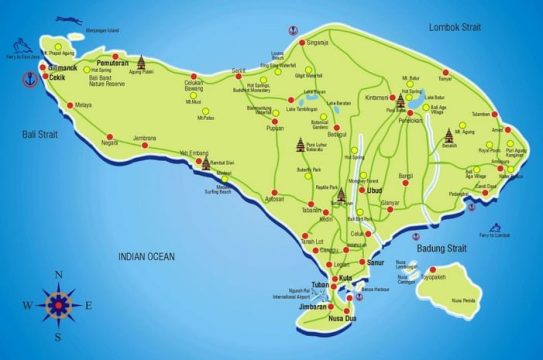
HIA’s analysis of the “Physical Demand Balance”—the difference between the growth of occupied room demand and room supply over the 12 months leading up to July 2026—reveals that Bali’s hotel performance varies significantly by geographic location. Sanur recorded the strongest performance, characterized by a very healthy balance between supply expansion and demand.
Meanwhile, the Jimbaran-Pecatu-Ungasan area is experiencing a demand-driven recovery. However, this region faces significant risk due to a concentration of new hotel projects—totaling 688 rooms—scheduled for completion through 2028.
Canggu-Seminyak and Nusa Dua are beginning to show signs of weakening; Revenue per Available Room (RevPAR) growth in Canggu-Seminyak has stagnated as room rate increases are constrained by declining occupancy. Furthermore, Kuta and Legian are experiencing a marked drop in demand. Kuta faces no issues regarding an influx of new room supply; rather, it is grappling with a crisis of appeal and a lack of demand recovery.
Meanwhile, Ubud presents a sharp contradiction: despite maintaining high room rates, room absorption there has contracted significantly. This issue threatens to worsen as new high-end hotel supply enters the market through 2027.
The “Bali Regional” area represents the most severe crisis point; regions outside the main tourism corridors are seeing a drastic drop in demand amidst already very low occupancy rates.
Hotel Class Polarization and the Illusion of Rising Rates (ADR):
Bali’s hotel market resilience is split not only geographically but also by class segment and chain affiliation. Luxury and upscale classes demonstrate the greatest resilience in physical demand. However, branded chain properties in this category will bear the heaviest burden of new room supply over the next 24 months. The upper-midscale and economy segments are experiencing a significant weakening in absorption, accompanied by a consistent decline in RevPAR.
“For the mid-to-lower segments, this decline is not caused by the entry of new competitors, but rather by a shrinking consumer base,” stated Woods. Woods also emphasized the dangers of relying on RevPAR as a sole metric. In markets such as Ubud, Nusa Dua, and Kuta-Legian, positive RevPAR or ADR growth creates an “illusion of recovery.” Hotel operators are raising rates to offset declining guest numbers, even as the actual volume of room nights sold continues to slide.
Australian Dominance and Chinese Uncertainty.
A narrowing diversity of source markets is exacerbating stagnant growth in foreign tourist arrivals to Bali in 2026. The Australian market is showing robust year-on-year growth of 6.2 percent, reaching 1.73 million visits and reinforcing its position as the backbone of Bali’s tourism sector. The Chinese market is projected to surge by 12.6 percent to 604,866 visits. However, it has the widest projection range—552,000 to 830,000—because of sensitivities around flight policies and domestic economic recovery.
Conversely, other international markets are experiencing significant declines: Malaysia (-11.0 percent), the UK (-6.5 percent), South Korea (-5.2 percent), and India (-4.4 percent).
”Consequently, Bali’s reliance on Australia is intensifying. Should economic conditions in Australia shift, the systemic risk to hotel occupancy rates in Bali would rise drastically,” said Woods.
Impact of Varying Future Scenarios
HIA utilized stochastic modeling to assess the market’s capacity to absorb the 2,460 new hotel rooms currently under construction across Bali. Under a moderate scenario, key areas such as Sanur, Canggu, and Jimbaran would still manage to maintain occupancy rates within the 68–84 percent range.
However, in a worst-case scenario—where geopolitical tensions and rising jet fuel prices disrupt air travel—occupancy rates would compress sharply. Average occupancy in Ubud could plummet to 47.7 percent, Jimbaran to 50.6 percent, and the broader Bali region to just 32.5 percent.
Therefore, Woods advises developers to stop relying on general assumptions about Bali’s tourism growth in project feasibility studies. “Developers must map out the actual completion schedules of competing projects within specific micro-locations,” he said.
Meanwhile, hotel owners and operators should avoid fixating solely on strategies to raise Average Daily Rates (ADR). “Management must prioritize physical market share, segmentation refinement, and operational cost efficiency,” Woods emphasized. For banks and creditors, while Bali’s Non-Performing Loan (NPL) ratio remains healthy at 1.38 percent, credit for new projects must undergo stress testing based on conservative scenarios rather than relying on average projections.
Fiercer Competition Ahead
In conclusion, Woods added, Bali’s hotel property ecosystem has shifted from recovery to a phase of mature absorption, characterized by much fiercer competition. “The investors and developers who endure are no longer those who merely rely on Bali’s renowned name, but rather those who possess keen analytical insight regarding location, superior product differentiation, and the financial resilience to withstand the risks of a market downturn,” concluded Woods.

Related Links
Bali’s Badung Regency Clumsily Cancels High-Cost Tourism Promotion Mission to Japan
Bali Hotel Trends: Sanur Strengthens, While Ubud and Other Areas Face Oversupply Issues
High Room Occupancy Does Not Guarantee Hotel Profitability in Bali
More Bali Visitors, But Staying for Shorter Periods
Travelers Abandon Bali for New Destinations
Bali to Ban Building More Hotels, Villas, & Restaurants
Bali Hotel Occupancy and Commercial Space Rental Lags
Anomalies in Bali Tourism – Arrivals Increase as Occupancies Plummet
Bali Hotel Occupancies Dive while Luxury Villas Thrive
Governor Koster: No Moratorium on Hotels & Villas
Escalating Overtourism in Bali
Stay Informed on Bali Tourism-Related News: Subscribe to Bali Update