
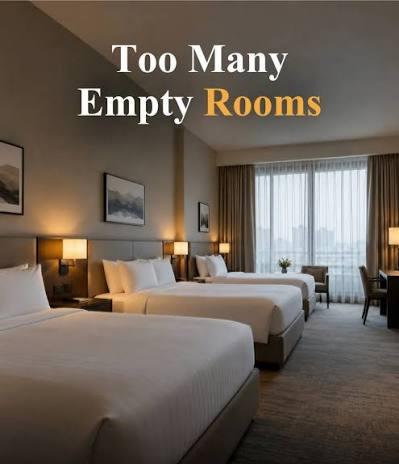
NusaBali reports that growing evidence of a surge in tourism properties in Bali being offered for sale does not necessarily indicate a sluggish tourism industry. Conversely, soft demand and lagging hotel occupancies highlight an oversupply of rooms that has been building for several years. The logical consequence is an inevitable price war—a situation tourism industry observers expect to worsen and escalate into an indeterminate, endless price conflict.
I Gusti Agung Rai Suryawijaya, Chairman of the Badung Chapter of the Indonesian Hotel and Restaurant Association (PHRI), views this phenomenon as a signal that requires government attention, particularly because accommodation supply continues to grow while Bali’s market capacity to absorb more rooms remains limited.
According to Agung Rai, random data collated with the Bali Tourism Office reveals that properties frequently listed for sale are villas that have already been built and are currently in operation. “It’s true that many villas are for sale. However, most of those being sold are villas that have already been constructed,” Agung Rai said on Wednesday, 30 September 2026.
He emphasized that property sales cannot simply be interpreted as a sole indicator that Bali’s tourism business is in trouble. For example, most hotels listed on the market remain operational, with occupancy rates above 60 percent, and some even reaching 75 percent.
In Agung Rai’s view—based on his 43 years of experience in hotel operations—an occupancy rate above 60 percent is still considered healthy. Under these conditions, hotels can still generate profits for owners, provide income for employees, and meet their tax obligations.

Consequently, Rai related, the reasons owners sell their properties vary. Beyond internal shareholder decisions, Agung Rai suspects that some owners are merely testing the market to gauge their assets’ value. He also dismissed the notion that these property sales are directly linked to any slump in foreign tourist arrivals. He noted that foreign tourist visits remain relatively stable. State Statistics Agency (BPS) data show that Bali received 3.90 million foreign tourist visits between January and July 2026. In July alone, visits reached 697,809—a 15.34 percent increase compared to June. However, BPS data also indicates that cumulative foreign tourist visits to Bali from January to June 2026 fell by 2.42 percent compared to the same period in 2025, dropping from 3.28 million to 3.20 million visits.
Agung Rai said the biggest pressure on hotel occupancy in Bali is currently coming from the domestic market. He estimates that domestic tourist visits in September will decline by approximately 15 percent. According to him, this is driven by factors such as high airfares, fewer government-organized meetings, and national economic conditions.
Meanwhile, the international market remains a key pillar of support. Agung Rai noted an average of around 22,000 foreign tourist arrivals per day across 43 flights. He also highlighted plans for additional flights from China, a new TransNusa route to Melbourne, and more direct charter flights from Moscow.
Agung Rai highlighted another issue affecting Bali’s hotel sector is the very rapid growth of accommodation supply. He warned that if the construction of hotels, villas, condotels, guesthouses, apartments, and other forms of accommodation continues to expand without regard for market capacity to absorb new rooms, business competition would become increasingly fierce.
“If the development of tourism accommodation continues unchecked like this, it will have a detrimental effect on the future of tourism. It will trigger a price war,” he said. According to Agung Rai, a price war will have a ripple effect. When prices are driven down, business revenues are likely to fall as well. A drop in revenue could, in turn, impact the service charges paid to hotel employees.
Ultimately, tax revenues will also suffer. Therefore, he believes Bali’s future strategy should not focus solely on increasing the number of rooms and accommodation units. “In my view, it is better to raise prices than to increase our supply,” he asserted.
Agung Rai urged the government and all stakeholders to study Bali’s carrying capacity to determine the limits of tourism growth. He proposed a three-to-five-year evaluation and restructuring process, including the option of a moratorium on accommodation development in areas where supply is already excessive.
He specifically highlighted the Sarbagita area—comprising the Denpasar, Badung, Gianyar, and Tabanan areas of Bali—as requiring attention and future control of accommodation development. Agung Rai also noted that the carrying capacity of Bali’s I Gusti Ngurah Rai Airport should act as a natural limiter on the growth of visitor numbers to Bali.
Agung Rai estimates that foreign tourist arrivals hover between 7 million and 7.5 million annually, while domestic tourists account for approximately 9 million to 10 million travelers. Given these conditions, Agung Rai proposed maintaining accommodation occupancy rates at around 90 percent before the government permits any further expansion of accommodation development.
“Only when the regional occupancy rate in Bali reaches 90 percent should we selectively open the tap again to allow the opening or construction of new tourism accommodation,” he said.

Beyond oversupply, the Badung Chapter of the Indonesian Hotel and Restaurant Association (PHRI) also identified legality issues with some of the properties being offered for sale. Agung Rai said he had received information from expatriate community members in Bali regarding properties built on land with problematic zoning status or lacking complete legal permits.
This situation becomes an even bigger issue when such properties are marketed via online platforms like Airbnb and Online Travel Agencies (OTAs). According to Agung Rai, accommodations listed on these platforms must comply with licensing regulations and possess a Regional Taxpayer Identification Number (NIB). He urged the government to find solutions for established businesses—including potential regulatory adjustments through Detailed Spatial Plans (RDTR)—that allow businesses now deemed ineligible to secure the necessary permits and complete tax registration despite being built on non-conforming land.
Agung Rai also believes that organized legalization could expand the local government’s tax revenue base from the tourism sector. Agung Rai views this approach as aligning with Bali’s tourism development direction, which prioritizes culture, quality, and dignity.
Related Links
Small Hotels in Bali Displaced by Airbnb, Bali Government Tightens Control on Digital Bookings.
Bali Hotels Threatened by Oversupply, Fueling Unhealthy Price Competition.
5,000 Tourism Businesses Begin Permit Process; Koster Insists ‘Legal’ Hotels Swamped with Bookings
Airbnb Private Villas Being Scrutinized by Bali Provincial Tax Authorities
Anomalies in Bali Tourism – Arrivals Increase as Occupancies Plummet
Bali Hotel Trends: Sanur Strengthens, While Ubud and Other Areas Face Oversupply Issues
Bali to Ban Building More Hotels, Villas, & Restaurants
Anomalies in Bali Tourism – Arrivals Increase as Occupancies Plummet
Bali Hotel Occupancies Dive while Luxury Villas Thrive
Escalating Overtourism in Bali
Stay Informed on Bali Tourism-Related News: Subscribe to Bali Update