
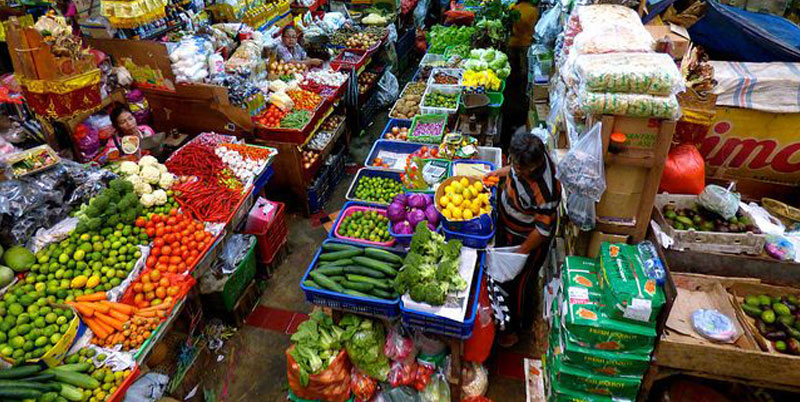
NusaBali reports that Bali Governor Wayan Koster has warned hotels and restaurants in Bali that are failing to optimize the use of local products that he will not hesitate to impose sanctions. Koster says he plans to tighten oversight by directly inspecting food supplies used by hotels and implementing a tiered sanctions system, potentially including reviewing business licenses for establishments that fail to comply with his guidance and official regulations.
Koster said he has tasked his staff with entering hotel kitchens to verify the origins of food ingredients, from rice, eggs, vegetables, and fruits to salt. He argued that Bali’s high volume of tourist arrivals should serve as a significant market for local farmers, livestock breeders, fishers, and domestic industry players.
“From an economic perspective, this is an existing market. People come here—7 million international visitors and 9.3 million domestic tourists, totaling 16.3 million annually! These visitors are people who need food,” Koster proclaimed during his remarks at the 2026 Stakeholder Dialogue hosted by the Bali Representative Office of Bank Indonesia (BI) held at the Dharma Negara Alaya Building in Denpasar on Friday, 23 October 2026.
Koster used the occasion to highlight Bali Gubernatorial Regulation No. 99 of 2018 addressing the Marketing and Utilization of Balinese Agricultural, Fishery, and Industrial Products. The Governor said hotels and restaurants that fail to use local products as required under the regulation will face three sequential formal warnings. If these businesses continue to disregard the regulations, the next step will be to review their business licenses.
According to Koster, Bali offers a diverse range of products that can meet the tourism industry’s needs. He cited examples such as rice from agricultural hubs like Tabanan, as well as local salt produced in Amed, Kusamba, and the Buleleng region. Therefore, he questioned the continued reliance on products from outside the region when local commodities are available and can meet market demand.
Koster emphasized that this issue goes beyond procurement choices by hotels and restaurants; it also concerns how the people of Bali can more broadly enjoy the economic benefits of tourism. If local producers meet the tourism industry’s needs, money can circulate to farmers, livestock breeders, fishers, artisans, and small-scale business owners.
“What I truly aim to build is a system where Bali’s economy circulates within Bali as much as possible—from upstream to downstream,” Koster stated.
In addition to using local food products, Koster also highlighted an existing policy requiring the use of Balinese “endek” woven fabric every Tuesday and traditional Balinese attire every Thursday. According to the Governor, this policy both preserves culture and strengthens the market for designers, weavers, tailors, and small and medium-sized enterprises (SMEs) in Bali.
Koster conveyed these messages during a forum themed “Data Pramana, Bali Rahayu: Synergizing to Drive Higher and More Resilient Growth for Bali.” The Governor hopes that by bolstering the use of local products, tourism growth will not merely be measured by visitor arrival totals, but will also generate a broader economic impact for the local community and local businesses.
Related Links
Activists Urge Plataran Ubud Resort Use Only Cage-Free Eggs
When in Bali, Wine and Dine Locally
Stay Informed on Bali Tourism-Related News: Subscribe to Bali Update
