

Where Muslim Residents Join in Carrying the *Tragtag* and *Bade* in Keramas
BeritaBali recently described a scene from Keramas Village in Gianyar Regency, Bali, that perfectly epitomizes the religious tolerance championed by the Indonesian State Philosophy of Pancasila.
This story unfolded on Sunday, 04 October 2026, at a “ngaben” (cremation) or “plebon” ceremony held for the late Gusti Agung Made Sita in Keramas Village, Blahbatuh District, Gianyar Regency, Bali.

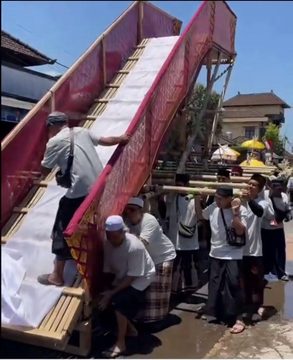
Amid a deeply Balinese-Hindu rite-of-passage ritual, Muslim residents of Kampung Sindu stood shoulder-by-shoulder with the local community. Muslims and Hindus walked together in a “pelebon” procession, which moved from the Puri Saren Kauh Palace to the nearby “Setra” (cemetery/cremation ground).
The Muslim residents of Kampung Sindu joined their Hindu neighbors in carrying the “tragtag”—a bamboo ladder used to raise and lower a body onto a waiting “bade” (cremation tower). In the accompanying photograph, the Muslim members serving as “tragtag” bearers are distinguished by the traditional pillbox-like “peci” headcoverings worn by Muslim men in Indonesia. This mutual assistance, or “gotong royong,” exemplifies the strong interfaith social bonds existing among the Muslims and Hindus living in Keramas Village.
A prominent Keramas resident, Gusti Agung Dharmada, explained that the Kampung Sindu Muslim Community’s participation in the burial of their friend and neighbor, Gusti Agung Made Sita, is part of a long-standing tradition of religious tolerance and mutual respect.
”The close relationship between the Muslim residents of Kampung Sindu and the Puri Keramas Palace is nothing new; it is a tradition that has been firmly woven dating from 1856,” said Gusti Agung Dharmada.
This relationship has deep historical roots. Centuries ago, six heads of families—the ancestors of the modern-day residents of Kampung Sindu—accompanied a nobleman as “security” on a journey from the “Puri” (palace) of Ida I Gusti Agung Made Moning in Lombok, traveling to Keramas, Gianyar, Bali.
As a gesture of appreciation, patronage, and familial bonding, the “Puri” in Keramas granted each Muslim escort a plot of land (”catu”) measuring 30 are (3,000 square meters). The Puri also established a place of worship—a “langgar” (small mosque)—for the Muslim residents.
That place of worship later evolved into one of Bali’s oldest mosques. To this day, that legacy remains an integral part of the lasting social ties between the Muslim residents of Kampung Sindu and the present-day extended Royal Family of Puri Keramas.
This ancient relationship continues to be nurtured through shared participation in traditional and religious activities in Keramas Village. The Muslim residents of Kampung Sindu proudly participate actively whenever the Puri Keramas Palace conducts traditional events or religious ceremonies.
For the local community, this relationship extends beyond mere participation in events; it has blossomed into a familial bond that spans generations.
”Our relationship with the Muslim residents involves mutual invitations whenever the Palace or the village community holds a traditional event,” Gusti Agung Dharmada explained.
The wholehearted involvement of Kampung Sindu’s Muslim residents in the *pelebon* (cremation) procession recently held in Keramas demonstrates how the tradition of *gotong royong* (cooperation) and social ties can create a space where people of different faiths happily come together. In Keramas Village, this tolerance remains vibrant through the community’s shared engagement in traditional and social life.
Related Links
Stay Informed on Bali Tourism-Related News: Subscribe to Bali Update