
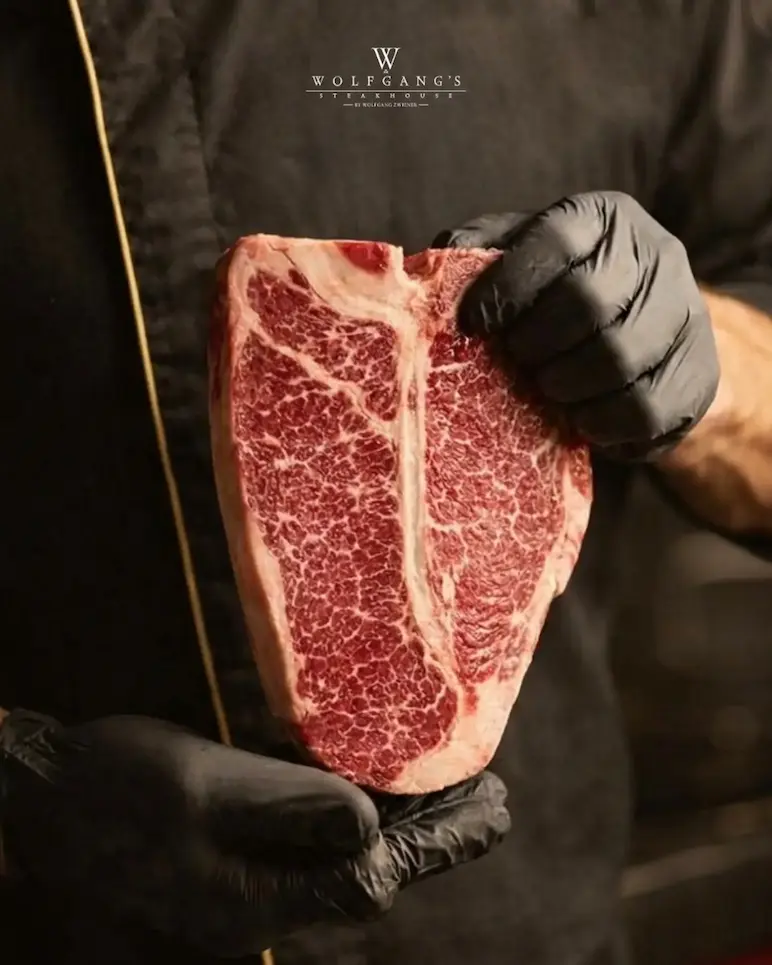
The world-renowned chain of American steakhouses, Wolfgang’s Steakhouse, opened on 21 August 2026, its 25th branch worldwide and 14th in Asia, at Parc Valle, Jalan Petitenget No. 6, Kuta, Badung, Bali.
Wolfgang’s Steakhouse in Bali marks the third Indonesian branch of the international restaurant franchise, offering its signature 28-day air-dried premium steaks. Two successful Wolfgang’s Steakhouses are already in operation in Jakarta.
This premium steakhouse, with roots tracing back to its original location on Park Avenue in Manhattan, New York, USA, arrives in Bali, bringing a classic New York-style steakhouse concept.

The Grand Opening of Wolfgang’s Steakhouse Bali in Petitenget marks the brand’s entry into the Bali market, a leading international holiday destination.
Speaking at the Bali Grand Opening, Peter Zwiener, co-founder of Wolfgang’s Steakhouse, said the Petitenget location in Bali was chosen because it sits in an area bustling with tourists, expatriates, and locals alike.”We have the perfect location; it is close by and within walking distance of many hotels. There are many tourists and locals, and it is a very vibrant area in Bali,” said Zwiener
Wolfgang’s Steakhouse uses only premium-quality imported meat from the USA.
Founded in Manhattan in 2004 by Wolfgang Zwiener and now carried on by his son, Peter Zwiener, the restaurant brand is known for serving classic American-style premium steaks, with dry-aging as one of its signature features.
USDA Prime Beef undergoes a 28-day dry-aging process before being broiled at temperatures up to 800 degrees Celsius. This process aims to create a caramelized crust on the outside while preserving the tenderness and flavor of the meat on the inside, preferably pink.
Wolfgang’s Steakhouse prepares meat that fulfills the strict USDA Prime Categorization. This is an elite category of meat reserved for the top 2 percent of total beef production in the United States.
“The three Indonesian branches are the first in the Company to use halal meat,” said Peter Zwiener,
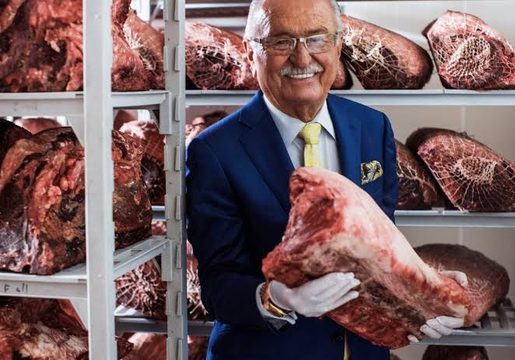
Peter Zwiener explained that the dry-aging process is carried out on-site at each restaurant. “We source all our beef fresh—never frozen. We buy directly from the slaughterhouse… So, for each of our 49 locations, we deliver the beef to the site and carry out the dry-aging process right there on the premises,” said Peter Zwiener.


During this process, the meat is stored at approximately 1 to 3 degrees Celsius and 70 percent humidity for about 28 days.
According to Wolfgang’s Steakhouse, the dry-aging process makes the meat more tender and produces a richer, more robust flavor.
Peter Zwiener noted that Bali was a key choice for the expansion of Wolfgang’s Steakhouse because its market characteristics align well with the restaurant’s concept.
Beyond being an international tourist destination, Bali is home to a local population and an expatriate community that contribute to the premium culinary market.
”That is why we are here in Bali; it represents a beautiful, culturally rich destination that attracts many tourists, while also drawing many local visitors. We want to bring the exceptional flavors of a New York-style steakhouse to Bali,” said Peter Zwiener.
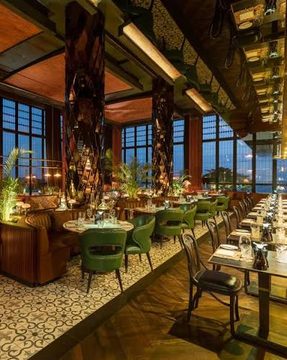
To that end, Wolfgang’s Steakhouse aims to blend Bali’s tropical atmosphere with the signature character of a New York steakhouse.
Meanwhile, Lydia D’Amato, Co-Founder of Wolfgang’s Steakhouse, emphasized the brand’s commitment to maintaining product and service quality across all locations.
She noted that successfully operating two locations in Jakarta has provided a foundation, giving her confidence to expand their network to Bali.
”Six years ago, you welcomed us to Jakarta—to your country—and we were received incredibly well. We have been warmly welcomed in Jakarta and across Southeast Asia, where we have also introduced our beach-style concepts. Today, we feel that Bali—with its tourism and expatriate community—is a destination people love to visit and make time for,” Lydia stated.
The arrival of Wolfgang’s Steakhouse at Parc Valle Petitenget offers more than just a premium steak menu. The restaurant offers a fine dining experience characterized by an elegant atmosphere, a curated wine selection, and a hospitality-focused service ethos.
It’s The Meat that Matters
While steaks are the obvious forte of Wolfgang’s Steakhouse, there’s more to their menu than merely premier quality cuts of beef. Appetizers include a tempting Beverly Hills Chopped Salad – a delicious combination of diced carrots, peas, corn, tomatoes, cucumbers, avocado, mint leaves, lettuce, red onion, and feta cheese. Fresh and slightly tangy, this salad is a perfect prelude to the hearty meat course just ahead.
Wolfgang’s Steakhouse also offers appealing seafood appetizers. This includes a sumptuous Seafood Platter featuring large chunks of crab meat, jumbo shrimp, and lobster. The lobster, crab chunks, and shrimp are generous in size – all cooked to perfection with a distinctive sweet, fresh flavor.
Another tempting starter that creates a dilemma of choice is the Salmon Salad, which features cooked salmon fillet and grilled asparagus.
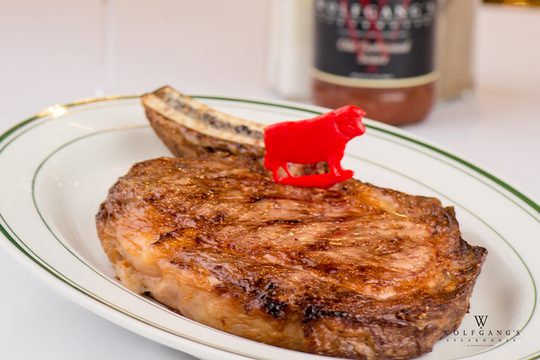
The “main event,” of course, is the steaks. You might consider a succulent Porterhouse Steak for Two.- considered a signature dish at Wolfgang’s, crafted from the finest USDA short loin beef. Cooked to a maximum medium-rare, the meat yields a beautiful gradient of red and pink hues when sliced for imminent delectable satiation.
The Porterhouse Steak is offered in two cuts: the tenderloin fillet and the New York Strip. Many prefer the Porterhouse for its savory flavor and moderate fat content. Others prefer fattier cuts and will opt for the rib steak.
Side dishes complementing the steak course can include mashed potatoes, German potatoes, or creamy spinach.
A word of caution: Wolfgang’s Steakhouse does not serve its steaks with sauce, preferring not to camouflage the meat’s authentic flavor. In keeping with this “purist” approach, the only seasoning used during cooking is a pinch of salt. Those who insist on “added sauce” can opt for Wolfgang’s Signature Sauce, which has a flavor profile similar to barbecue sauce but with a slightly tangier note.
Loyal to New York stalwart stand-bys, a meal can include one of Wolfgang’s-style cakes that include: Lime Pie, New York Cheesecake, Chocolate Mousse Cake, and Pecan Pie.
More About Dry Aging
Many high-end steakhouses employ a dry-aging process for their meat. This process imparts a distinctive flavor and texture that enhances the meat’s taste. Broadly speaking, dry aging is a process involving the bacterial breakdown of the meat.
Premium meats must be hung and aged to promote tenderization. The bacteria involved in dry aging are safe because the meat is kept in a specially designed room where conditions—such as temperature, humidity, and airflow—are all rigorously controlled.
“Dry-aging” is usually reserved for large cuts of meat—typically the short loin and rib sections. These large cuts are stored in specialized rooms or chambers maintained at approximately 1–3 degrees Celsius. Humidity levels are maintained at no more than 70 percent, and the room is equipped with fans to ensure proper airflow.
Meat is “hung” in special rooms for about 28 days. During this time, the meat becomes more tender and develops a distinctive flavor—such as a unique, earthy note.
The dry-aging process causes the outer layer of the meat to dry out and shrink. This dried outer layer acts as a natural seal, locking in the juices and moisture within the meat.
By retaining these internal juices, the taste-enhancing moisture content is prevented from escaping. The juices—which are the source of the meat’s flavor—become concentrated within the meat, resulting in a more tender texture and a more robust taste.
The beef selected for dry aging typically contains a significant amount of muscle tissue. During the process, chemical reactions cause these muscle fibers to contract and eventually break down.
Dry-aged meat is known for being expensive. The dry-aging process is lengthy, complex, and capital-intensive, which not surprisingly automatically drives up the price of the meat. The meat used for dry-aging cannot be limited to small cuts; it must be processed into large, whole primary cuts. During the aging process, the outer layer of the meat dries out, oxidizes, and shrinks, resulting in about 60 percent of the meat being lost, leaving only around 40 percent saleable. The outer parts of the aged meat are trimmed away and discarded before cooking. The longer the meat is aged, the more of the dried-out exterior must be discarded.
For instance, if you dry-age five kilograms of meat, you might be left with only about two kilograms to cook and serve.
The price is high because the buyer effectively pays for five kilograms of meat, even though they consume only two.
The specialized dry-aging equipment itself is also quite expensive. A sophisticated dry-aging machine with a 20-kilogram capacity costs 2,695 euros, or approximately Rp 41 million.
Wolfgang’s Steakhouse Bali
Jl. Petitenget No. 6
Kerobokan Kelod, Kec. Kuta Utara
Kabupaten Badung, Bali 80361
Reservations Telephone: +62 818-1886-8688
Wolfgang’s Steakhouse Bali on Google Maps
Related Links
Wolfgang;s Steakhouse Bali Website
Wolfgangs; Steakhouse Bali Menu
Bali’s Best Steaks are Served in a Garage!
Gourmet Garage: Bali’s Best Value for Steak
Stay Informed on Bali Tourism-Related News: Subscribe to Bali Update
