

The State News Agency ANTARA reports that the rare appearance of an “oar fish”—often dubbed the “doomsday fish”—was found stranded on Pink Beach in Sekaroh Village, East Lombok, West Nusa Tenggara (NTB) on Tuesday, 25 August 2026. is suspected to be linked to climate change occurring across the Indian Ocean.
Muslim, the Head of the NTB Marine and Fisheries Agency, stated that oarfish sightings in West Nusa Tenggara are extremely rare. However, the fish’s appearance is associated with factors such as temperature, weather, and climate change in the Indian Ocean.
“This fish lives in the deep sea; its appearance here could be due to temperature changes in the waters of the Indian Ocean,” Muslim said in Mataram on Wednesday.
According to Muslim, the sea temperature fluctuations presumed to have caused the oarfish to appear at Pink Beach could stem from various factors, ranging from weather conditions to earthquakes.
“Temperature changes can occur due to earthquakes. Coincidentally, an earthquake just occurred in NTT [East Nusa Tenggara]. Our entire southern region borders the Indian Ocean, and we share the same tectonic plate as NTT,” he explained.
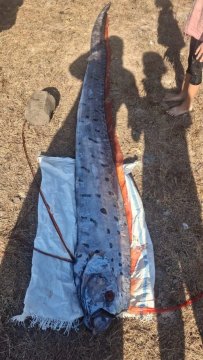
Therefore, Muslim noted, it is hypothesized that the oar fish’s appearance might be somehow linked to the impact of the earthquake that struck NTT on 15 August 2026.
“One could assume the fish appeared due to the recent NTT earthquake, but proving this requires further scientific study and research,” Muslim emphasized.
Nevertheless, he acknowledged that many people often associate the appearance of this fish with myths predicting impending disaster, hence the nickname of “doomsday fish,” However, Muslim points out that this myth has not been scientifically proven.
“While this myth hasn’t been scientifically proven, let us just hope that nothing bad happens,” he concluded.
More About the Oar Fish – Doomsday Fish
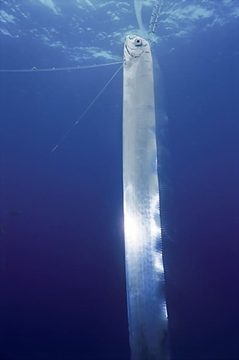
The oar fish is widely known as the “doomsday fish” – a name linked to ancient legends and folklore that claim seeing one near the surface or at the beach is a warning sign of an upcoming natural disaster, like an earthquake or tsunami.
.
The giant oar fish is reputed to be the longest bony fish alive, growing up to about 8 m in length.
Although larger oar fish are treated as game fish and are fished commercially on a small scale, they are rarely caught alive; their flesh is not well regarded as food due to its gelatinous consistency.
The oar fish is seldom seen at the ocean’s surface, except when the fish is sick or dying. This characteristic helps explain, at least in part, why they have been mistakenly identified as sea serpents. Their occasional beaching before storms has also lent to their reputation as a harbinger of doom. Numerous oarfish washed ashore before the disastrous 2011 Tōhoku earthquake and tsunami.
Their beachings before storms have gained them a reputation as harbingers of doom,[6] a folk belief reinforced by the numerous beachings before the disastrous 2011 Tōhoku earthquake and tsunami.
Related Links
NTT Declares Emergency Response Disaster Following Devastating Earthquakes
Earthquake-Tsunami Disaster Readiness Drill Conducted in Bali
Frequency of Earthquakes in Bali on the Increase
Stay Informed on Bali Tourism-Related News: Subscribe to Bali Update
