
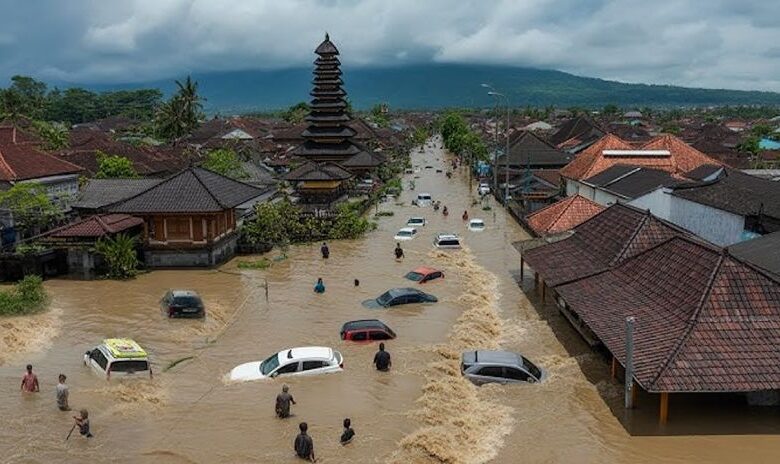
BeritaBali reports that ten Bali residents, representing several community organizations, have filed a class-action citizens’ lawsuit to stem climate change-related damage in Bali. They accuse the government, including President Prabowo and Governor Koster, and seek a moratorium on business permits for new fossil fuel infrastructure projects. The suit also asks the Minister of Energy and Mineral Resources to accelerate the transition to more eco-friendly measures in line with the Paris Agreement.
The suit also seeks to compel courts to serve as the last line of defense by requiring the state to align its energy policies with Intergovernmental Panel on Climate Change (IPCC) recommendations.


The class action suit by the PULIHKAN Bali (Restore Bali) public advocacy group (Nomor perkara 1024/Pdt.G/2026/PN Dps) was lodged on 02 July 2026 with the Denpasar Court. It marks the first class-action climate-change case filed in Bali and aims to curb the growing number of environmental disasters affecting the island, including the devastating Sarbagita Floods in September 2025.
Ni Putu Candra Dewi and Ni Luh Yunaelis, the attorneys representing PULIHKAN Bali, say their legal action is the first climate lawsuit in Bali to compel the state to meet its obligation to protect the environment and support the public’s environmental rights.
“The rights to environmental conservation represent human rights. In court, we will prove how the 14 defendants, including the President and regional heads in Bali, are guilty of systemic negligence that has impacted citizens’ rights,” the two female lawyers said.
PULIHKAN Bali is urging a moratorium on the issuance of business permits, which they say accelerates environmental damage. Based on data presented by the group, the Sarbagita regions of Bali lost approximately 6,522 hectares of rice fields from 2019 to 2024, averaging 1,087 hectares per year, due to the unprincipled facilitation of changes in agricultural land use. The group cites reduced water catchment areas and a lack of green open spaces as factors that have increased the risk of flooding in Bali.
The legal coalition linked the massive flooding that inundated Denpasar and the regencies of Badung, Gianyar, and Tabanan (Sarbagita) in September 2025, resulting in 18 deaths, 295 people evacuated from their dwellings, hardship for 6,209 households, damage to 520 public facilities, and the destruction of three bridges and 23 main roadways. The PULIHKAN Bali Advocacy Team rejects the Bali Provincial Government’s claim that the natural disaster was solely triggered by heavy rainfall. Based on the group’s research, the 99 millimeters of rainfall recorded in just 24 hours was a trigger, while the primary cause was the cumulative effect of environmental factors and governance failures.
The coalition study found that the disasters were related to uncontrolled land conversion, limited green open space to absorb rainfall, poor waste management, unintegrated watershed management, a suboptimal flood early warning system, and a lack of comprehensive climate change policies.
The group also highlighted that between 1999 and 2025, 147 floods occurred in Bali, affecting thousands of victims. It also said that the Meteorological, Climate, and Geophysics Agency’s (BMKG) early warnings on 03 and 05 September 2025 were not followed by sufficient mitigation measures.

The legal coalition stated that it urged the government to improve governance after the September 2025 floods. However, it contends that no follow-up actions have been taken, which it says amounts to official gross negligence in the face of a known risk.
In the class action lawsuit, ten Balinese residents are suing 14 heads of state agencies: the President, the Minister of Finance, the Minister of Energy and Mineral Resources, the Minister of Investment, the Minister of Environment, the Minister of Forestry, the Minister of Public Works, the Minister of ATR/BPN (National Land Agency), the Governor of Bali, the Bali Provincial Legislative Council (DPRD), the Mayor of Denpasar, the Regent of Badung, the Regent of Gianyar, and the Regent of Tabanan.
PULIHKAN Bali is demanding government policies that support climate justice, tighten controls on land conversion, develop disaster-mitigation-based spatial planning, impose a moratorium on permits that could damage the environment, and strengthen Strategic Environmental Assessments (KLHS) and environmental audits.
The group alleges that the government has violated at least three constitutional rights of residents: the right to a healthy, safe environment, the right to a sense of security, and the right to protection from the threat of natural disasters.
The lawsuit also highlights the Bali Provincial Government’s failure to commit to the energy transition and Net-Zero Emissions targets. The coalition says there is a mismatch between the green development narrative and on-the-ground development policies.
“We are bringing this case to the Denpasar District Court to effect a structural change in official policy. We want the judge to acknowledge that the 18 lives lost last year were the result of decades of state negligence. Through this Citizen Lawsuit, we are demanding the restoration of the Balinese people’s ecological rights. We also want to ensure that future generations will not be drowned by floods, and that the government improves and carries out better governance,” said Ignatius Rhadite, a PULIHKAN Bali attorney, during a press conference on Tuesday, 07 July 2026.
Suriadi Darmoko, one of the residents who filed the lawsuit, believes the climate crisis in Bali has not been addressed seriously, even though the issue is frequently raised in international forums.
“We are suing because we are tired of seeing real crises in the region used as a commodity for speeches abroad without any concrete, legally binding action at home,” said Darmoko.
The coalition also seeks to highlight plans to develop fossil fuel infrastructure in Bali, which it believes contradict the spirit of the clean energy transition.
“Bali’s commitment to a clean energy transition is being tested. On the one hand, it claims to be moving towards green energy, but on the other, Bali is plagued by plans to develop fossil gas infrastructure. As part of climate change mitigation, through this citizen lawsuit, we demand a moratorium on business permits for new fossil fuel infrastructure projects and that the Minister of Energy and Mineral Resources accelerate the energy transition in accordance with its obligations under the Paris Agreement. The courts are the last bastion to force the state to align its energy policies with the IPCC’s scientific recommendations,” Darmoko concluded.
Meanwhile, Ni Putu Candra Dewi and Ni Luh Yunaelis, the plaintiffs’ attorneys, emphasized that this case is the first climate lawsuit in Bali to test the state’s responsibility to protect the community’s environmental rights.
”As environmental rights are part of human rights, in court, we will prove how the 14 defendants, including the President and regional heads in Bali, are guilty of systemic negligence that has impacted the rights of citizens,” they said.
The coalition is also urging a moratorium on the issuance of business permits, which they believe could accelerate environmental damage. Based on their data, the Sarbagita area lost approximately 6,522 hectares of rice fields between 2019 and 2024, averaging 1,087 hectares annually. The reduction in water catchment areas and the lack of green open spaces are said to increase the risk of flooding in Bali.
Related Links
Timor-Leste Provides Rp. 41 Billion in Flood Relief Bali
Poor Land Use Policies Blamed for Bali’s Floods
9 Dead After Floods Ravage South Bali
RI Tourism Minister Says Floods Will Not Cause Decline in Bali Visitors
Ubud Bali’s Main Street Closed by Bridge Collapse
Stay Informed on Bali Tourism-Related News: Subscribe to Bali Update